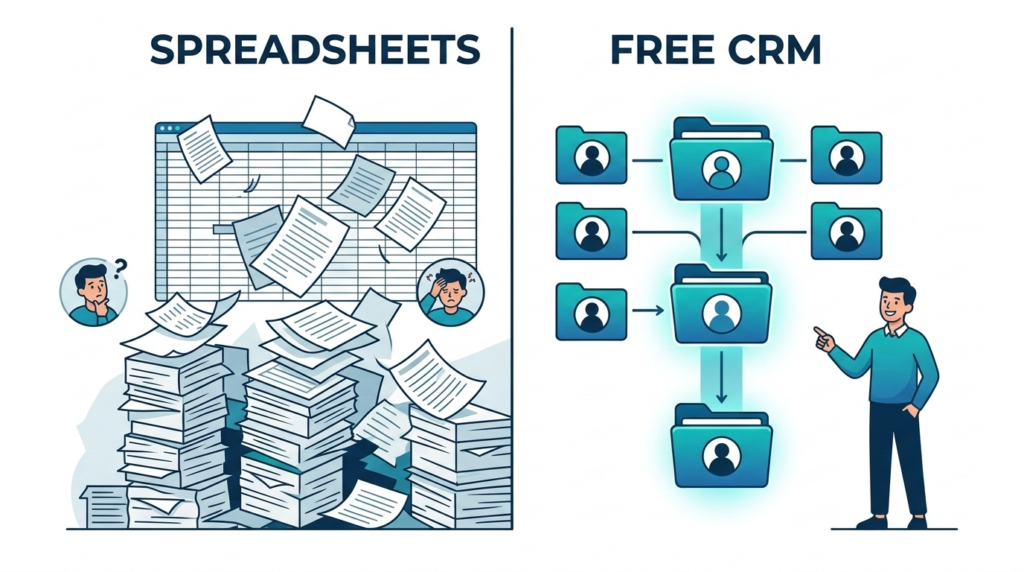
Startups must move away from static spreadsheets to a dynamic CRM database to prevent data fragmentation.
Are you launching a startup with more ambition than capital? You aren’t alone. In the volatile economy of 2026, where efficiency is the only currency that matters, nearly 90% of startups fail—not necessarily due to a bad product, but often due to poor customer management and unsustainable burn rates. Choosing the best free CRM software for startups is not just a way to save money; it is a strategic maneuver to build a robust data foundation while keeping your overhead at zero.
For founders managing a team of 1 to 50 people, the “freemium” model is a gift, but it can also be a minefield. Many tools offer a free tier only to lock your data behind a massive paywall the moment you start seeing success. In this comprehensive guide, we strip away the marketing jargon and analyze the top free CRM solutions for 2026. You will learn not only which tools are free but how to extract maximum ROI from a zero-dollar investment.
1. The Startup Evolution: Why Spreadsheets are Your Biggest Enemy in 2026
In the “garage phase” of a startup, a shared Google Sheet or Excel file feels like the path of least resistance. It’s free, everyone knows how to use it, and it’s flexible. However, in 2026, the speed of business has accelerated. A spreadsheet is a static graveyard of information, whereas a CRM is a living, breathing ecosystem.
The Hidden Costs of “Free” Spreadsheets
- Data Fragmentation: When your co-founder talks to an investor on LinkedIn and you email a lead via Gmail, that data is siloed. A CRM centralizes this instantly.
- Lack of Automation: A spreadsheet won’t remind you to follow up. It won’t track if a lead opened your pitch deck or ignored your proposal.
- Security Risks: Spreadsheets are easily copied, deleted, or shared with the wrong people. Professional CRMs offer role-based access control even on free tiers, ensuring your IP stays protected.
The “Single Source of Truth” Philosophy
For a startup to scale from 2 people to 50, every team member must have access to the same history. When a salesperson leaves or a new marketing lead joins, the CRM ensures that the “institutional memory” of your startup stays within the company. This continuity is vital for maintaining investor confidence and customer trust.
2. Deep Dive: The Titans of Free CRM for 2026
The leading free CRM platforms each offer a unique value proposition for 2026’s diverse startup landscape.
HubSpot CRM: The Ecosystem Play
HubSpot has dominated the free CRM market for a decade, and in 2026, their free offering is more robust than ever. They follow a “Land and Expand” strategy: they give you incredible free tools knowing that as you grow, you will eventually transition into their premium hubs.
- The Core Offering: Unlimited users and up to 1 million contacts. This is virtually unparalleled in the SaaS industry.
- Marketing Integration: You get free forms, landing pages, and basic email marketing tools that integrate directly with your sales pipeline.
- Sales Tools: Access to “Deals” pipelines, basic task management, and meeting scheduling links that sync with Google Calendar.
- The Verdict: HubSpot is the best choice for startups that plan to scale aggressively and want a “pro” feel from day one.
Zoho CRM: The Customization Powerhouse
If your startup operates in a niche industry (e.g., Biotech, specialized Manufacturing, or FinTech), a “one-size-fits-all” CRM might not work. This is where Zoho CRM shines.
- Free Edition Limits: Supports up to 3 users, which is perfect for a founding team.
- Customization: Zoho allows you to change fields, layouts, and modules more deeply than most other free tiers.
- Developer Friendly: If you have a technical co-founder, Zoho’s API and integration options are highly sophisticated for a free product.
- The Verdict: Best for tiny technical teams who need specific data fields and specialized reporting right out of the gate.
Freshsales: The User Experience Leader
Freshsales (by Freshworks) is designed for startups that value speed and a clean User Interface (UI). It feels like using a high-end consumer app rather than a clunky corporate database.
- Unique Selling Point: Built-in phone and email tools. You can actually make calls directly from the browser on the free plan in many regions.
- 24/5 Support: Unlike many competitors who limit free users to community forums, Freshsales often provides direct email support to their free-tier users.
- The Verdict: Ideal for sales-heavy startups that spend the majority of their time on outreach and want zero friction in their daily workflow.
3. Technical Implementation: Setting Up Your CRM for Scale
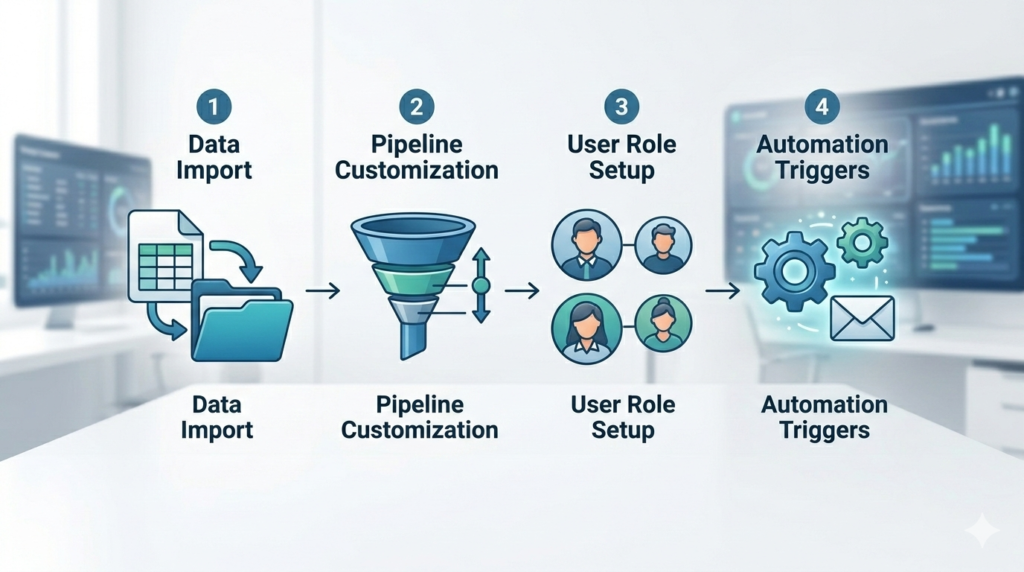
Properly configuring your CRM during the technical implementation phase is vital for long-term data equity.
A common mistake startups make is signing up for a CRM and then failing to configure it. To ensure long-term success, follow this implementation roadmap.
Step 1: Defining Your Sales Stages
Don’t use the default stages provided by the software. Customize your pipeline to match your actual customer journey:
- Lead Inbound: Initial contact via website or LinkedIn.
- Qualified: The lead meets your Ideal Customer Profile (ICP).
- Value Discovery: A meeting where you identify their specific pain points.
- Proposal Sent: A formal offer or pitch deck has been delivered.
- Closing: Final negotiations or legal review.
Step 2: Automation for the Busy Founder
As a founder, you are the CEO, the salesperson, and the support agent. Use these free automation triggers to save hours every week:
- Auto-Responders: When someone fills out a “Contact Us” form, the CRM should send an immediate, personalized “We received your message” email.
- Automatic Task Creation: Every time a new lead enters the system, a task should be assigned to follow up within 24 hours. This prevents “lead decay.”
4. Measuring ROI on a Zero-Dollar Investment
The true ROI of a zero-dollar CRM investment is measured in reclaimed founder time and captured opportunity data.
How can a free tool have a Return on Investment? In the startup world, ROI isn’t just about cash out; it’s about Time and Opportunity.
- Efficiency Gains: If a CRM saves each team member 5 hours a week on manual data entry, that is 20 hours a month for a 4-person team. At a founder’s hourly value, that is thousands of dollars in “recovered” time.
- Lead Recovery: One lead that would have been forgotten in a spreadsheet but was saved by a CRM reminder can be worth the entire “mental cost” of setting up the system.
- Data Equity: As you collect data on customer behavior, you are building an asset. When you eventually go for a Series A or B funding round, having three years of clean, organized CRM data is a massive “trust signal” for VCs.
5. Strategic Industry Scenarios: CRM in Action
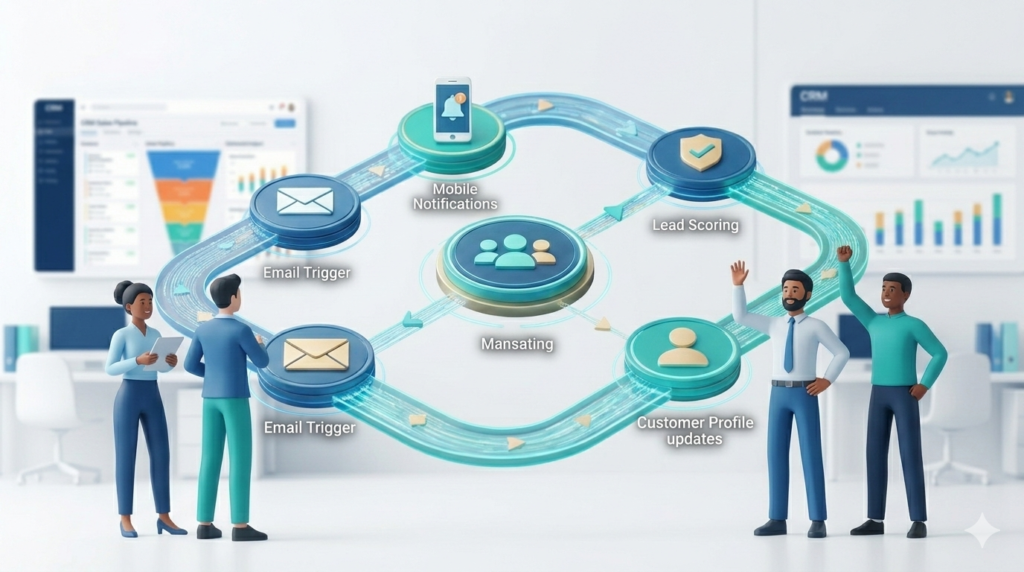
Startups should only upgrade their CRM when they have outgrown the free limitations or require advanced predictive AI tools.
Scenario A: The B2B SaaS Startup
In this scenario, the startup needs to track “Trial Signups.” By integrating their free CRM with their web app, they can see exactly when a user stops using the product and trigger a “Check-in” email. This reduces churn before the user even decides to cancel.
Scenario B: The Creative Agency
A 5-person agency uses a free CRM to manage high-value relationships. Because their sales cycle is long (3-6 months), the CRM’s “Interaction History” is crucial. When a client calls after three months of silence, the founder can see every previous conversation in seconds, making the agency appear incredibly attentive.
6. The “Freemium” Trap: What to Watch Out For
While these tools are excellent, they are designed to lead you toward a paid plan. Be aware of these common limitations in free tiers:
- Storage Limits: You might be limited to 5GB of file storage. Don’t use your CRM as a cloud drive for heavy videos or high-res designs.
- Reporting Caps: You can see who your customers are, but you might not be able to generate a “Sales Forecast” report without upgrading.
- API Limits: If you try to connect too many third-party apps, the free tier might “throttle” your data sync.
7. Conclusion: The Best CRM is the One Your Team Actually Uses
The best free CRM software for startups in 2026 is not necessarily the one with the most features on paper; it is the one that fits your team’s natural workflow. If a tool is too complex, your co-founders will revert to using Slack messages and sticky notes.
Start with HubSpot for ease of use, Zoho for deep customization, or Freshsales for a sales-first approach. Get your data organized today, and you will be miles ahead of your competition tomorrow.
Frequently Asked Questions About Best Free CRM Software for Startups
Q1: Is a free CRM really free forever?
Yes, most major providers offer a “Forever Free” tier. They benefit by having you in their ecosystem so that when you become a billion-dollar “unicorn,” you are already using their platform.
Q2: Can I send mass marketing emails with a free CRM?
Usually, free plans have strict limits (e.g., 2,000 emails per month). For massive newsletters, you may eventually need a dedicated marketing tool or an upgraded plan.
Q3: How safe is my startup’s data in a free tier?
Extremely safe. Providers like HubSpot and Zoho use the same high-level encryption for free users as they do for their multi-million dollar enterprise clients.
Q4: Which free CRM is best for a solo founder?
Zoho CRM is fantastic for solo founders who want to “tweak” everything, while HubSpot is better if you want a system that works “out of the box” in 10 minutes.
Q5: Can I integrate a free CRM with my existing website?
Yes, almost all free CRMs provide a “Web-to-Lead” form or a simple WordPress plugin to capture leads directly into your database.
Q6: What happens if I want to switch CRMs later?
You can export your data as a CSV file. While moving systems is never “fun,” it is a standard process that all CRMs support.
Q7: Do free CRMs offer AI tools in 2026?
Basic AI, such as contact auto-completion and simple data cleaning, is now common in free tiers. However, “Predictive Sales AI” is usually a paid feature.
Q8: Can I manage my investors in a CRM?
Absolutely. Many startups create a separate “Investor Pipeline” to track outreach, pitch deck views, and follow-up meetings with VCs.
Q9: Does HubSpot’s free CRM limit the number of users?
In 2026, HubSpot still offers unlimited users on its free CRM tier, which is its biggest competitive advantage for growing teams.
Q10: How do I train my team to use a free CRM?
Most providers offer “Academies” or free YouTube certifications. Set aside 2 hours on a Friday for your team to go through the basic training.
Q11: Is technical support available for free users?
Typically, no. You will rely on “Community Forums” and “Knowledge Bases.” However, these are usually very detailed and solve 99% of common issues.
Q12: Do I need to provide a credit card to sign up?
No. Legitimate free CRM plans should only require a business email to start your account.